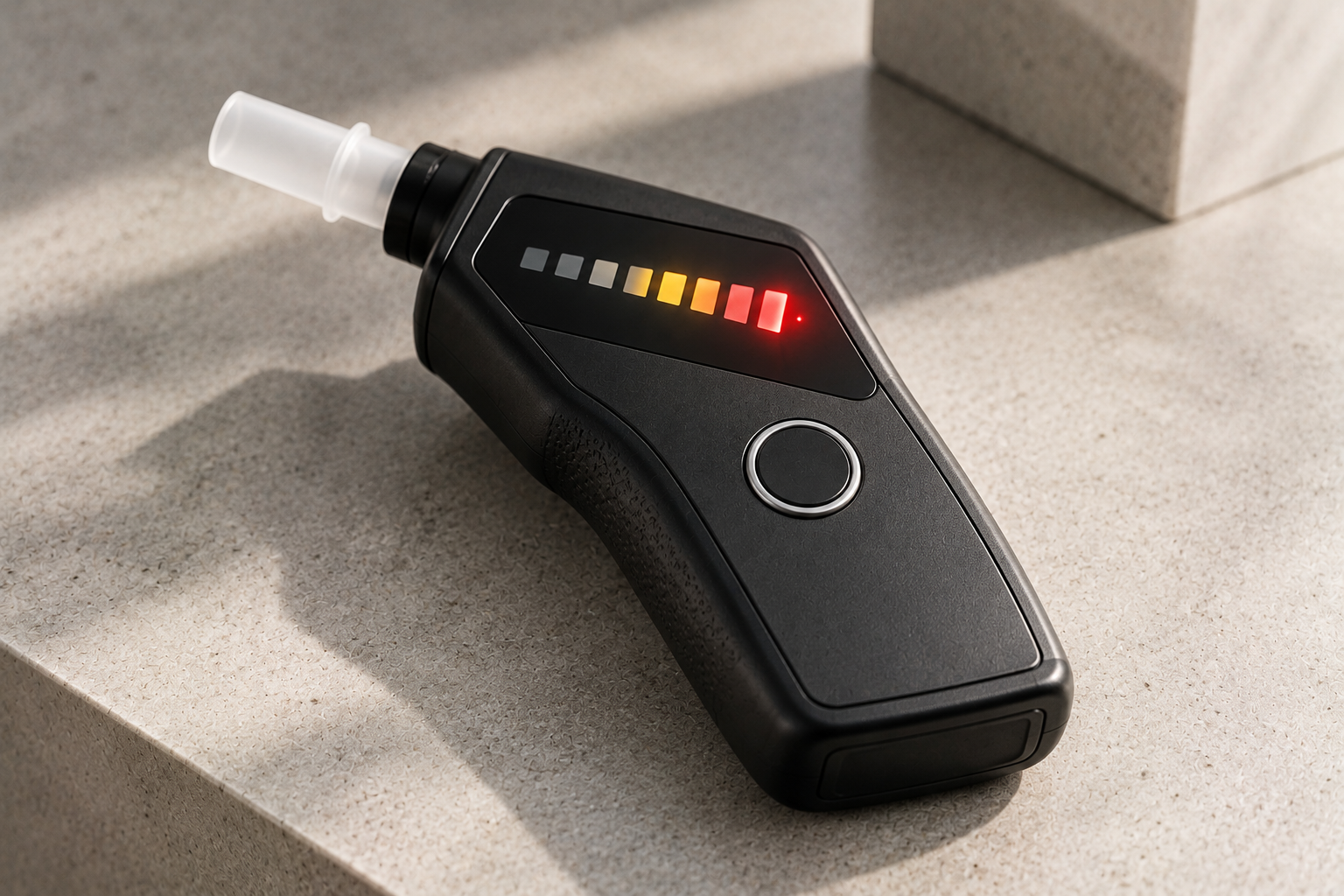
- Different devices, different roles: roadside screeners (ASDs) and station breathalyzers (Intoxilyzers) use different technologies for different legal purposes.
- Breath test results can differ due to timing, residual mouth alcohol, calibration issues, and individual physiology.
- Failing the station test leads to charges, even if you passed the roadside test.
- The police station Intoxilyzer result usually takes precedence, as it’s considered the evidentiary sample in court.
- Technical and legal defences exist to challenge inconsistent or flawed test results.
- Immediate legal help is critical to protect your rights and dispute questionable evidence.
The Roadside Screening: Understanding the Approved Screening Device (ASD)
When police pull you over and suspect impaired driving, they first use a portable device called an Approved Screening Device (ASD). It’s crucial to understand that this is fundamentally different from the machine at the police station.How Roadside Devices Work
Roadside screening devices are designed for quick, preliminary assessment. Most use fuel cell technology that detects alcohol presence in your breath. Think of an ASD as a sophisticated pass/fail screening tool—like a metal detector at an airport—rather than a precise measuring instrument. The ASD typically gives one of three results:- Pass: No alcohol detected or below the warning range
- Warn: Between 50 mg/100 mL up to 100 mg/100 mL of blood
- Fail: the device is set to “fail” at readings of 100 mg/100 mL of blood or higher
Your Rights During Roadside Testing
Understanding your rights during roadside breath sample testing is essential. You cannot refuse an ASD demand under Canada’s Mandatory Alcohol Screening laws, but you do have specific protections about how the test is conducted. Police must:- Observe you for up to 15 minutes if they suspect you have consumed alcohol within the last 15 minutes before testing to ensure there is no mouth alcohol
- Use a properly calibrated, approved device
- Explain the consequences of refusal
- Follow proper procedures for the test administration
The Police Station Test: The Role of the Evidentiary Breathalyzer (Intoxilyzer)
If the roadside test results in a fail (i.e., a blood alcohol concentration of 100 mg./100 mL of blood or higher), you will be arrested and taken to the station for evidentiary breath testing. In most cases, if the results of the roadside test are in the warn range, you will not be arrested but the police will give you a 3-day administrative driver’s licence suspension and also typically impound your vehicle for 3 days. However, if the police form reasonable grounds to believe your ability to operate a vehicle was impaired by alcohol or a drug based on observations (i.e., slurred speech, odour of alcohol on your breath, erratic driving, balance issues etc.), you could still be arrested and brought to the police station and be required to provide Intoxilyzer breath samples which may or may not show you are under the legal limit. The ASD reading alone does not determine whether you are impaired as it only screens for your level of blood alcohol concentration (“BAC”) at the time you were stopped by the police. The police might also determine that you are impaired by a drug even if you pass a roadside test or the test result is in the warn range. For example, if you have a rising blood alcohol level in your system, you might then fail an Intoxilyzer test at the police station because the alcohol was not in your blood stream at the time of the roadside test. These are more rare situations but they do occur. An example would be if you had quickly consumed a couple of shots of alcohol just before being stopped by the police. Those shots would potentially not be in your blood stream at the time of the roadside test, but lead to a rising blood alcohol level. You might then fail the Intoxilyzer test at the police station an hour or two later.How Station Devices Differ
The station “breathalyzer” – typically an Intoxilyzer – is a much more sophisticated instrument designed to produce precise BAC readings which are admissible in court. While roadside devices use fuel cell technology, most Intoxilyzers use infrared spectroscopy, which measures how alcohol molecules absorb specific wavelengths of light. Key differences include:- Purpose: Evidentiary vs. screening
- Technology: Infrared spectroscopy vs. fuel cell
- Precision: Exact BAC vs. pass/warn/fail categories
- Legal weight: Intoxilyzers provides Court-admissible evidence vs. the roadside screening device merely provides grounds for arrest
The Station Testing Process
At the station, you’ll typically provide two breath samples at least 17 minutes apart. The Intoxilyzer performs internal checks and calibrations between tests. Unlike the roadside test, you have the right to contact a lawyer before providing these samples—though you cannot unreasonably delay the testing process. For more detailed information about alcohol breath testing procedures, understanding these technical aspects can be crucial to your defence.Why Would a Roadside Breath Test and Station Test Show Different Results?
Contradictory results between roadside and station testing can occur for several legitimate technical reasons. Understanding these factors is crucial for building an effective defence.Timing: The Difference Between Two Tests
The most significant factor is often timing. Alcohol absorption and elimination in your body is dynamic, not static. Consider these scenarios: Rising Blood Alcohol: If you consumed alcohol shortly before driving, your BAC might still be rising when you take the roadside test but peak by the time you reach the station. This could explain passing the roadside test but failing at the station. Declining Blood Alcohol: Conversely, if alcohol was already being eliminated from your system, your BAC might drop between the roadside test and station testing.Mouth Alcohol vs. Deep Lung Air
Both devices can be affected by “mouth alcohol” – residual alcohol in your mouth, throat, or esophagus from recent drinking, burping, regurgitation, or even acid reflux. However, they may react differently:- ASD Impact: Might register a “fail” from mouth alcohol contamination
- Intoxilyzer Impact: More sophisticated devices may detect mouth alcohol patterns, but can still produce inflated readings if there is mouth alcohol present.
Device Sensitivity and Calibration
Different Technologies, Different Sensitivities: Fuel cell sensors (roadside) and infrared spectroscopy (station) have different sensitivity profiles and may respond differently to interfering substances or environmental factors. Calibration Standards: Each device type has different calibration requirements and maintenance schedules. An improperly calibrated device can produce false readings.Physiological and Environmental Factors
Several factors can affect breath test accuracy differently across devices:- Partition Ratio Variability: The 2100:1 breath-to-blood ratio assumption can vary significantly between individuals
- Medical Conditions: Diabetes, GERD, or respiratory conditions may affect readings differently on each device
- Environmental Factors: Temperature, air pressure, and electromagnetic interference
- Improper Administration: Officer error in device operation or procedure
I Passed the Roadside Test But Failed at the Station: What Happens Now?
This scenario often catches people off guard, but legally, the station test typically takes precedence because it’s the evidentiary sample used for criminal charges.Immediate Consequences
Even though you passed the roadside test, failing the station breathalyzer triggers: Criminal Charges: You’ll likely be charged with “over 80” under the Criminal Code, regardless of the roadside result. Administrative Penalties: Immediate 90-day licence suspension, vehicle impoundment, and fines apply based on the station result. Bail Conditions: You may face strict conditions to secure your release on bail and especially if you have a prior criminal record for impaired driving.Why the Station Test Usually Matters More
The station breathalyzer is considered the “evidentiary” instrument because:- It’s more precise and designed for court use
- Results include specific BAC numbers, not just pass/fail
- The testing environment is more controlled
- Calibration and maintenance records are more rigorous compared to the roadside Alcotest devices.
I Failed the Roadside Test But Passed at the Station: Am I in the Clear?
This less common scenario creates interesting legal complexities. While you might think you’re safe, the situation isn’t automatically resolved.Legal Implications
Potential Charges: Depending on the circumstances, you could still face charges based on:- Officer observations of impairment beyond breath tests
- Field sobriety test results
- Failing a Drug Recognition Evaluation at the police station resulting in you being charged with operating a conveyance while being impaired by a drug or a combination of alcohol and a drug.
Defence Opportunities
This scenario often provides strong defence opportunities because:- The more accurate station test contradicts the roadside result
- It raises questions about ASD reliability and calibration
- It may indicate mouth alcohol contamination affected the roadside test
- It demonstrates the importance of proper testing procedures
Building Your Defence: How a DUI Lawyer Can Challenge Contradictory Evidence
Contradictory breath test results don’t automatically invalidate charges, but they create significant defence opportunities that require experienced legal analysis.Technical Challenges to Breath Testing
Disputing the accuracy of breathalyzers in Ontario DUI charges involves examining multiple technical factors: Device Maintenance and Calibration: Reviewing calibration records, maintenance logs, and quality assurance testing for both devices. Operator Training and Procedure: Analyzing whether officers followed proper protocols for both roadside and station testing. Interference Factors: Investigating potential sources of interference like mouth alcohol, medical conditions, or environmental factors.Procedural and Charter Challenges
Beyond technical challenges, your lawyer will examine: Right to Counsel: Whether your Charter rights were properly respected before evidentiary testing. Reasonable Grounds: Whether police had proper grounds for arrest and demanding station testing. Disclosure: Ensuring the Crown provides all relevant evidence, including maintenance records and officer training documentation. For comprehensive information about challenging inaccurate roadside breath tests, understanding these defence strategies is crucial.Expert Evidence and Technical Testimony
Contradictory results often require expert testimony to explain:- The technical differences between devices
- Factors that could cause discrepant results
- The reliability and limitations of each testing method
- Alternative explanations for the observed results
Your Next Step: Why Immediate Legal Counsel is Non-Negotiable
Whether you passed one test and failed another, or you’re facing charges despite contradictory results, immediate legal representation isn’t optional—it’s essential.Time-Sensitive Evidence
Your lawyer needs to act quickly to:- Preserve calibration and maintenance records
- Interview witnesses while memories are fresh
- Review police video footage and notes
- Identify potential Charter violations
Specialized Knowledge Required
DUI defence involving contradictory breath tests requires lawyers who understand:- The technical operation of both device types
- Forensic toxicology and breath testing science
- Specific procedures required under Canadian law
- How to effectively cross-examine technical witnesses
Frequently Asked Questions
Q: Can I still be charged if I passed the roadside test but failed at the station? A: Yes. The police station Intoxilyzer is the evidentiary instrument used for criminal charges. However, the contradictory roadside result can be valuable evidence for your defence. Q: Which breath test result do the courts care about more? A: Generally, the station test (Intoxilyzer) carries more weight because it’s designed for evidentiary purposes and provides precise BAC readings. However, both results and their contradictions can be relevant to your case. Q: What if I think the police administered the tests incorrectly? A: Procedural errors in test administration can be grounds to challenge the evidence. Your lawyer will review all procedures to identify potential violations of testing protocols or your Charter rights. Q: How long after drinking can these discrepancies occur? A: Discrepancies are most likely when testing occurs during the absorption phase when blood alcohol levels are still rising or beginning to decline. The absorption phase for alcohol happens fairly quickly, with effects starting in about 5-10 minutes and usually peaking between 30-90 minutes. Q: Can I refuse testing if I already gave a sample at the roadside? A: No. Even if you provided a roadside sample, you cannot refuse evidentiary testing at the station. Refusal is a separate criminal offence with penalties often more severe than impaired driving. Don’t let contradictory breath test results confuse you into thinking you don’t need legal help. These situations require immediate, expert analysis to protect your rights and build the strongest possible defence. Contact Kruse Law today for a confidential consultation about your specific situation.
Michael Kruse is a seasoned criminal defence lawyer with more than 36 years of experience in Ontario. A former Assistant Crown Attorney, Mike brings decades of courtroom and trial experience to the defence of serious criminal charges. He leads Kruse Law Firm with a strategic, practical approach focused on strong advocacy and achieving the best possible outcome for every client.